Most people misunderstand Dharma as religion. This is not accurate. Dharma simply means righteousness — the right duty and right actions in every circumstance. These duties and actions bring us closer to God, our higher self. This is the simplest definition of Dharma.
To practice Dharma in daily life requires deeper understanding. Saints have said that this world is a cosmic drama. We are all playing characters, while God is the writer and director. Dharma is our script — it instructs us how to play our role and what actions we must take in this divine play. Therefore, Dharma is the most important aspect of our life. When we do not know our Dharma, it is like acting without a script — that is why we suffer.
So how do we find our script — our Dharma? If we lack a script, we naturally reach out to the writer or director. Similarly, to know our Dharma, we must establish our connection with God or a self-realized guru. A self-realized guru can also tell us our Dharma. All religions, in essence, aim to teach us how to make that connection. This is where yoga and spiritual practices come in. Paramhansa Yogananda and the ancient scriptures define yoga as union — a scientific union with God.
Paramhansa Yogananda always mentioned in his books and in his talks: “Meditate on God unceasingly”, seek God, talk to God, and do what He tells you. He was sharing the same knowledge which we also find in old scriptures like the Bhagavad Gita (18.62) and the Bible (Matthew 6:33). All saints and scriptures spread the same knowledge in different ways.
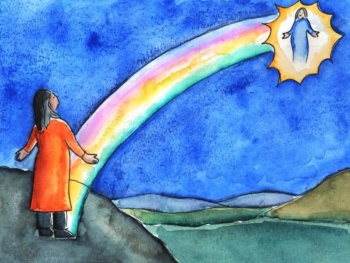
Image credits:
Whisper and Art: I Want to Build a Rainbow-Bridge of Self-Realization – Ananda Europe
https://share.google/vysDQKC5ScsjU2mEv
Dharma is not just a philosophical or theoretical concept. One must experience it through practice, if he sincerely practices yoga and spiritual discipline. As we move toward our higher self through yoga or any spiritual practice, divine guidance begins to reveal our Dharma. In the Bhagavad Gita, Lord Krishna reminds Arjuna of his Dharma — the right duty and the right action in the battlefield of Kurukshetra. Krishna guides Arjuna toward his highest responsibility as a soul in that situation. Likewise, any self-realized master can also guide us toward our Dharma.
Dharma is personal and unique for every individual. It may differ based on one’s role — such as one’s duty toward family, society, or nation. Yet, the highest Dharma of every soul is to seek God and establish that connection, through which we truly come to know our real Dharma.
Performing Dharma is also performing right karma. This is why the Upanishads say that human life consists of four aspects: Dharma, Artha, Kama, and Moksha. To truly understand Artha (ethical earning and service), Kama (right desires), and Moksha (ultimate liberation), one must first understand Dharma. That is why saints and scriptures give Dharma the highest emphasis.
Paramhansa Yogananda greatly emphasized World Brotherhood Colonies. Through this concept, he practically demonstrated how to live all four aspects — Dharma, Artha, Kama, and Moksha — in daily life. Living according to Dharma is a lifelong journey, and perhaps each sincere step toward truth brings us nearer to our higher self. When we begin to live our Dharma consciously, the cosmic drama becomes clearer, and the soul slowly remembers its divine purpose.
I pray for all, may we all find our Dharma, perform it with sincerity, and move one step closer to God. In the end, I thank all the readers.
This is my humble attempt to explain Dharma in simple words, by my Guru’s grace.